
Pablo Picasso
Overview
His name in full was Pablo (or Pablito) Diego Jose Santiago Francisco de Paula Juan Nepomuceno Crispin Crispiniano de los Remedios Cipriano de la Santisima Trinidad Ruiz Blasco y Picasso Lopez. His father was José Ruiz y Blasco; his mother Maria Picasso y Lopez. In his early years he signed his name Ruiz Blasco after his father, but decided to use his mother's name from about 1901 on.
Picasso was born in Malaga, Spain and is probably most famous as the founder, along with Georges Braque, of Cubism. However in a long life he produced a wide and varied body of work, the best-known being the Blue Period works which feature moving depictions of acrobats, harlequins, prostitutes, beggars and artists.
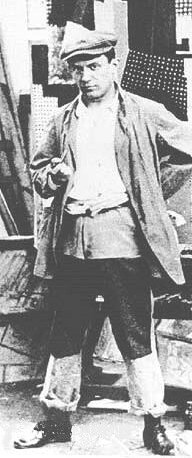
A young Pablo Picasso
While Picasso was primarily a painter (in fact he believed that an artist must paint in order to be considered a true artist), he also worked with small ceramic and bronze sculptures, collage and even produced some poetry. "Je suis aussi un poète," as he quipped to his friends.
Picasso hated to be alone when he wasn't working. In Paris, in addition to having a distinguished coterie of friends in the Montmartre and Montparnasse Quarters, including Andre Breton, Guillaume Apollinaire, writer Gertrude Stein and others, he usually maintained a number of mistresses in addition to his wife or primary partner.
Picasso's most famous work is probably his depiction of the German bombing of Guernica, Spain. This large canvas embodies for many the inhumanity, brutality and hopelessness of war. The painting of the picture was captured in a series of photographs by Picasso's most famous lover, Dora Maar, a distinguished artist in her own right. A Nazi officer is supposed to have come to his door brandishing a postcard and demanding, "Did you do this?" "No," Picasso is supposed to have replied, "you did." The Guernica hung in New York's Museum of Modern Art for many years, and is now in Madrid -- Picasso stipulated that the painting should not return to Spain until democracy was restored in that country.
As certain works, for example the Cubist pieces, tend to be associated in the public mind with Picasso, it is important to realize how talented Picasso was as a painter and draughtsman. He was capable of working with oils, watercolours, pastels, charcoal, pencil, ink, or indeed any medium with equally high facility. With his most extreme cubist works he came close to deconstructing a complex scene into just a few geometric shapes while at the same time being capable of photo-realistic pen and ink sketches of his friends. Picasso had a massive talent for almost any artistic endeavor he turned his mind to, despite limited formal academic training (he finished only one year of his course of study at the Royal Academy in Madrid), and a ferocious work-ethic.
Early Life
Picasso's father Don José Ruiz y Blasco was himself a painter and for most of his life was a professor of art at Spanish colleges. It is from Don José that Picasso learned the basics of formal academic art training - figure drawing, and painting in oil. Although Picasso attended art schools thoughout his childhood, often those his father taught at, he never finished his college level course of study at the Royal Academy of San Fernando in Madrid, leaving after less than a year.
The Picasso Museum in Barcelona features many of Picasso's early works, created while he was living in Spain, as well as the extensive collection of Jaime Sabartés, Picasso's close friend from his Barcelona days, and for many years, Picasso's personal secretary. There are many precise and detailed figure studies done in his youth under his father's tutelage that clearly demonstrate his firm grounding in classical techniques, as well as rarely seen works from his old age.
Picasso and Pacifism
It is true that Picasso remained neutral during the Spanish Civil War, World War I and World War II, refusing to fight for any side or country. Picasso never commented on this but encouraged the idea that it was because he was a pacifist. Some of his contemporaries though (including Braque) felt that this neutrality had more to do with cowardice than principle.
As a Spanish citizen living in France, Picasso was under no compulsion to fight against the invading Germans in either world war. In the Spanish Civil War, service for Spaniards living abroad was optional and would have involved a voluntary return to the country to join either side. While Picasso expressed anger and condemnation of Franco and the Fascists through his art he did not take up arms against them.
He also remained aloof from the Catalan independence movement during his youth despite expressing general support and being friendly with activists within it. No political movement seemed to compel his support to any great degree.
After the Second World War, Picasso joined the French Communist party, and even attended an international peace conference in Poland. But party criticism of a portrait of Stalin as insufficiently realistic cooled Picasso's interest in Communist politics.
Personal Life
Picasso had a long string of lovers, four children by three women, and two wives. In the early years of the 20th century, Picasso, still a struggling youth, began a long term relationship with Fernande Olivier. It is she who appears in many of the Blue and Rose period paintings. After garnering fame and some fortune, Picasso left Fernande for Marcelle Humbert, whom Picasso called Eva. When it became clear that Eva was dying, Picasso left her as well. Throughout his life, Picasso also frequented bordellos, and had numerous affairs.
In 1918 Picasso married Olga Koklova, a ballerina with Sergei Diaghilev's troupe. Olga introduced Picasso to high society, formal dinner parties, and all the social niceties attendant on the life of the rich in 1920s Paris. The two had a son, Paulo, who would grow up to be a sometime motorcycle racer, sometime chauffeur to his father, and dissolute.
Olga's insistence on social propriety clashed with Picasso's bohemian tendencies, and the two lived in a state of near constant conflict. In 1927 Picasso met the then underage (17) Marie Thérèse Walter, and began a secret affair with her. Picasso's marriage to Olga soon ended in separation, as French law required an even division of property in the case of divorce, and Picasso did not want Olga to have half his wealth. The two remained legally married until Olga's death in 1955.
Picasso carried on a long standing affair with Marie Thérèse, and fathered a daughter, Maya, with her. Marie Thérèse lived in the vain hope that Picasso would one day marry her, and eventually hanged herself after Picasso's death.
The photographer and painter Dora Maar was also a constant companion and lover of Picasso. The two were closest in the late 30s and early 40s, and it was Dora who documented the painting of Guernica. Like all the women in his life, Dora was cruelly abused emotionally by the narcissistic Picasso.
After the liberation of Paris in 1945, Picasso began to keep company with a young art student, Françoise Gilot. The two eventually became lovers, and had two children together, Claude, and Paloma. Uniquely among Picasso's women, Françoise eventually left Picasso in 1953 because of his abusive treatment, and infidelities. This came as a severe blow to Picasso, who was used to submissive women who lived for whatever scraps of affection or attention he deigned to give them.
>He went through a difficult period after Françoise's departure, coming to terms with his advancing age, and his perception that he was an old man, now in his seventies, who was no longer attractive, but rather grotesque to young women. A number of ink drawings from this period explore this theme of the hideous old dwarf as buffoonish counterpoint to the beautiful young girl.
Picasso was not long in finding another lover, Jacqueline Roque. Jacqueline worked at the Madoura Pottery, where Picasso made and painted ceramics. The two remained together for the rest of Picasso's life, marrying in 1961. Their marriage was also the means of one last act of revenge against Françoise. Françoise had been seeking a legal means to legitimize her children with Picasso, Claude and Paloma. With Picasso's encouragement, she had arranged to divorce her then husband, Luc Simon, and marry Picasso to secure her children's rights. Picasso then secretly married Jacqueline after Françoise had filed for divorce in order to exact his revenge for her leaving him.
Later Works
In his 80s and 90s, Picasso, no longer quite the energetic dynamo he had been in his youth, became more, and more reclusive. His second wife, Jacqueline Roque, screened all but the most important visitors, and closest friends, even excluding Picasso's two children, Claude and Paloma, both by his former partner, the painter, Françoise Gilot.
This reclusive existence intensified after Picasso underwent surgery for a prostate condition in 1965. This surgery is rumored to have left Picasso largely impotent. To a man for whom sexual adventure was such an important part of life, this was a serious life change, and Picasso seems to have dealt with it by redoubling his already prolific artistic output.
Devoting his full energies to his work, Picasso became more daring, his works more colorful and expressive, and from 1968 through 1971 he produced a torrent of paintings and hundreds of copperplate engravings. At the time these works were dismissed by most as pornographic fantasies of an impotent old man, or the slapdash works of an artist who was past his prime. One long time admirer, Douglas Cooper called them "the incoherent scribblings of a frenetic old man in the antechamber of death." Only a decade later, after Picasso's death, when the rest of the art world had moved on from abstract expressionism, did the critical community come to see that Picasso had already discovered neo-espressionism, and was, as usual, ahead of his time.
Pablo Picasso died on April 8, 1973 at Mougins, France, and was interred at Castle Vauvenargues' park, in Vauvenargues, Bouches-du-Rhône. Jacqueline prevented his children, Claude and Paloma from attending the funeral.
At the time of his death, Picasso, by now a multi millionaire, owned a vast quantity of his own work, consisting of personal favorites which he had kept off the art market, or which he had not needed to sell. In addition, Picasso had a considerable collection of the work of other famous artists, some his contemporaries, like Henri Matisse, with whom he had exchanged works. Since Picasso left no will, his death duties, or estate tax to the French state were paid in the form of his works, and others from his collection. These works form the core of the immense, and representative collection of the Musée Picasso in Paris.
In 1999, Picasso's Les Noces de Pierrette (The Marriage of Pierrette) sold for more than $51 million USD.
External links
- Pablo Ruiz Blasco y Picasso (Picasso) : 400 works
- Musée Picasso, Paris
- Wikiquote - Quotes by Pablo Picasso
More Great Thinkers Great Minds
- Marie Curie
- Pablo Picasso
- Edwin Hubble
- Jean Piaget
- Robert Boyle
- Plato
- Rene Descartes
- Miguel de Cervantes
- Friedrich Nietzsche
- Michelangelo Buonarroti
- Gary Kasparov
- Galileo Galilei
- Dmitri Mendeleev
- Archimedes
- Albert Einstein
- Isaac Newton
- Leonhard Euler
- Enrico Fermi
- Joseph Louis Lagrange
- Carl Friedrich Gauss
- Bernhardt Riemann
- Kurt Gödel
- William Shakespeare
- Betrand Russell
- Charles Darwin
- Fyodor Dostoevsky
- Leo Tolstoy
- Niels Bohr
- Linus Pauling
- Leonardo Da Vinci
- Blaise Pascal
- Michael Faraday
- James Clerk Maxwell
- Aristotle
- Alan Turing
- Sigmund Freud
- Gottfried Leibniz
- Max Planck
- Aleksandr Pushkin
- Ivan Pavlov
- Pierre de Fermat
- Johann Wolfgang von Goethe
- Steven Hawking
- Steve Jobs