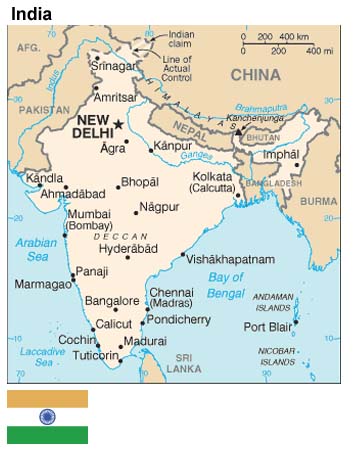
| Background
Note: India PROFILE
OFFICIAL NAME: Republic of India Geography
Area: 3.29 million sq. km. (1.27 million sq. mi.); about one-third
the size of the U.S. Cities: Capital--New Delhi (pop. 12.8 million,
2001 census). Other major cities--Mumbai, formerly Bombay (16.4 million);
Kolkata, formerly Calcutta (13.2 million); Chennai, formerly Madras (6.4 million);
Bangalore (5.7 million); Hyderabad (5.5 million); Ahmedabad (5 million); Pune
(4 million). Terrain: Varies from Himalayas to flat river valleys. Climate:
Alpine to temperate to subtropical monsoon. People Nationality:
Noun and adjective--Indian(s). Population (2004): 1.1 billion; urban
27.8%. Annual growth rate: 1.3% Density: 324/sq. km. Ethnic groups: Indo-Aryan
72%, Dravidian 25%, Mongoloid 2%, others. Religions: Hindu 82.41%, Muslim
12%, Christian 2.3%, Sikh 1.9%, other groups including Buddhist, Jain, Parsi 2.5%. Languages:
Hindi, English, and 16 other official languages. Education: Years compulsory--
None. Literacy--65.42%. Health: Infant mortality rate--54.6/1,000.
Life expectancy--64.7 years. Work force (est.): 450 million. Agriculture--62%;
industry and commerce--22%; services and government--12%; transport
and communications--4%. Government
Type: Federal republic. Independence: August 15, 1947. Constitution:
January 26, 1950. Branches: Executive--president (chief of state), prime
minister (head of government), Council of Ministers (cabinet). Legislative--bicameral
parliament (Rajya Sabha or Council of States, and Lok Sabha or House of the People).
Judicial --Supreme Court. Political parties: Bharatiya Janata Party,
Indian National Congress (INC), Janata Dal (United), Communist Party of India,
Communist Party of India-Marxist, and numerous regional and small national parties.
Political subdivisions: 28 states,* 7 union territories. Suffrage: Universal
over 18. Economy GDP
(FY2005-06): $797 billion. Real growth rate (FY2005-06): 8.4%. Per capita
GDP (FY2005-06): $761. Natural resources: Coal, iron ore, manganese, mica,
bauxite, chromite, thorium, limestone, barite, titanium ore, diamonds, crude oil. Agriculture:
21% of GDP. Products--wheat, rice, coarse grains, oilseeds, sugar, cotton,
jute, tea Industry: 28% of GDP. Products--textiles, jute, processed
food, steel, machinery, transport equipment, cement, aluminum, fertilizers, mining,
petroleum, chemicals, and computer software. Services and transportation: 51%
of GDP. Trade: Exports (FY2005-06)--$105 billion; agricultural products,
engineering goods, precious stones, cotton apparel and fabrics, gems and jewelry,
handicrafts, tea. Software exports--$22 billion. Imports (FY2005-06)
156 billion; petroleum, machinery and transport equipment, electronic goods, edible
oils, fertilizers, chemicals, gold, textiles, iron and steel. Major trade partners--U.S.,
China, EU, Russia, Japan. PEOPLE Although
India occupies only 2.4% of the world's land area, it supports over 15% of the
world's population. Only China has a larger population. Almost 33% of Indians
are younger than 15 years of age. About 70% live in more than 550,000 villages,
and the remainder in more than 200 towns and cities. Over the thousands of years
of its history, India has been invaded from the Iranian plateau, Central Asia,
Arabia, Afghanistan, and the West; Indian people and culture have absorbed and
modified these influences to produce a remarkable racial and cultural synthesis.
Religion, caste, and language are major
determinants of social and political organization in India today. The government
has recognized 18 official languages; Hindi, the national language, is the most
widely spoken, although English is a national lingua franca. Although 82% of its
people are Hindu, India also is the home of more than 138 million Muslims--one
of the world's largest Muslim populations. The population also includes Christians,
Sikhs, Jains, Buddhists, and Parsis. The
Hindu caste system reflects Indian occupational and socially defined hierarchies.
Ancient Sanskrit sources divide society into four major categories, priests (Brahmin),
warriors (Kshatriya), traders (Vaishya) and farmers/laborers (Shudra).
Although these categories are understood throughout India, they describe reality
only in the most general terms. They omit, for example, the tribes and those once
known as "untouchables." In reality, Indian society is divided into thousands
of jatis--local, endogamous groups based on occupation--and organized hierarchically
according to complex ideas of purity and pollution. Despite economic modernization
and laws countering discrimination against the lower end of the caste structure
and outlawing "untouchability," the caste system remains an important source of
social identification and a potent factor in the political life of the country.
Nevertheless, the government has made strong efforts to minimize the importance
of caste through active affirmative action and social policies. Moreover, caste
has been diluted if not subsumed in the economically prosperous and heterogeneous
cities, where an increasing percentage of India's population lives. In the countryside,
expanding education, land reform and economic opportunity through access to information,
communication, transport, and credit have lessened the harshest elements of the
caste system. HISTORY
The people of India have had a continuous civilization since 2500 B.C., when
the inhabitants of the Indus River valley developed an urban culture based on
commerce and sustained by agricultural trade. This civilization declined around
1500 B.C., probably due to ecological changes. During
the second millennium B.C., pastoral, Aryan-speaking tribes migrated from the
northwest into the subcontinent, settled in the middle Ganges River valley, and
adapted to antecedent cultures. The
political map of ancient and medieval India was made up of myriad kingdoms with
fluctuating boundaries. In the 4th and 5th centuries A.D., northern India was
unified under the Gupta Dynasty. During this period, known as India's Golden Age,
Hindu culture and political administration reached new heights. Islam
spread across the subcontinent over a period of 700 years. In the 10th and 11th
centuries, Turks and Afghans invaded India and established sultanates in Delhi.
In the early 16th century, Babur, a Turkish adventurer and distant relative of
Timurlang, established the Mughal Dynasty, which lasted for 200 years. South India
followed an independent path, but by the 17th century large areas of South India
came under the direct rule or influence of the expanding Mughal Empire. While
most of Indian society in its thousands of villages remained untouched by the
political struggles going on around them, Indian courtly culture evolved into
a unique blend of Hindu and Muslim traditions. The
first British outpost in South Asia was established by the English East India
Company in 1619 at Surat on the northwestern coast. Later in the century, the
Company opened permanent trading stations at Madras (now Chennai), Bombay (now
Mumbai), and Calcutta (now Kolkata), each under the protection of native rulers.
The British expanded their influence
from these footholds until, by the 1850s, they controlled most of present-day
India, Pakistan, Sri Lanka, and Bangladesh. In 1857, an unsuccessful rebellion
in north India led by Indian soldiers seeking the restoration of the Mughal Emperor
caused the British Parliament to transfer political power from the East India
Company to the Crown. Great Britain began administering most of India directly,
while controlling the rest through treaties with local rulers. In
the late 1800s, the first steps were taken toward self-government in British India
with the appointment of Indian councilors to advise the British Viceroy and the
establishment of Provincial Councils with Indian members; the British subsequently
widened participation in Legislative Councils. Beginning in 1920, Indian leader
Mohandas K. Gandhi transformed the Indian National Congress political party into
a mass movement to campaign against British colonial rule. The party used both
parliamentary and nonviolent resistance and non-cooperation to agitate for independence.
During this period, however, millions of Indians served with honor and distinction
in the British armed forces, including service in both World Wars and countless
other overseas actions in service of the Empire. With
Indians increasingly united in their quest for independence, a war-weary Britain
led by Labor Prime Minister Clement Attlee began in earnest to plan for the end
of its suzerainty in India. On August 15, 1947, India became a dominion within
the Commonwealth, with Jawaharlal Nehru as Prime Minister. Strategic considerations,
as well as political tensions between Hindus and Muslims, led the British to partition
British India into two separate states: India, with a Hindu majority; and Pakistan,
which consisted of two "wings," East and West Pakistan--currently Bangladesh and
Pakistan--with Muslim majorities. India became a republic within the Commonwealth
after promulgating its Constitution on January 26, 1950. After
independence, the Indian National Congress, the party of Mohandas K. Gandhi and
Jawaharlal Nehru, ruled India under the leadership first of Nehru and then his
daughter (Indira Gandhi) and grandson (Rajiv Gandhi), with the exception of brief
periods in the 1970s and 1980s, during a short period in 1996, and the period
from 1998-2004, when a coalition led by the Bharatiya Janata Party governed. Prime
Minister Nehru governed the nation until his death in 1964. Nehru was succeeded
by Lal Bahadur Shastri, who also died in office. In 1966, power passed to Nehru's
daughter, Indira Gandhi, Prime Minister from 1966 to 1977. In 1975, beset with
deepening political and economic problems, Mrs. Gandhi declared a state of emergency
and suspended many civil liberties. Seeking a mandate at the polls for her policies,
she called for elections in 1977, only to be defeated by Morarji Desai, who headed
the Janata Party, an amalgam of five opposition parties. In
1979, Desai's Government crumbled. Charan Singh formed an interim government,
which was followed by Mrs. Gandhi's return to power in January 1980. On October
31, 1984, Mrs. Gandhi was assassinated, and her son, Rajiv, was chosen by the
Congress (I)--for "Indira"--Party to take her place. His Congress government was
plagued with allegations of corruption resulting in an early call for national
elections in 1989. Although Rajiv Gandhi's
Congress Party won more seats than any other single party in the 1989 elections,
he was unable to form a government with a clear majority. The Janata Dal, a union
of opposition parties, then joined with the Hindu-nationalist Bharatiya Janata
Party (BJP) on the right and the Communists on the left to form the government.
This loose coalition collapsed in November 1990, and the Janata Dal, supported
by the Congress (I), came to power for a short period, with Chandra Shekhar as
Prime Minister. That alliance also collapsed, resulting in national elections
in June 1991. While campaigning in Tamil
Nadu on behalf of Congress (I), Rajiv Gandhi was assassinated on May 27, 1991,
apparently by Tamil extremists from Sri Lanka, unhappy with India's armed intervention
to try to stop the civil war there. In the elections, Congress (I) won 213 parliamentary
seats and returned to power at the head of a coalition, under the leadership of
P.V. Narasimha Rao. This Congress-led government, which served a full 5-year term,
initiated a gradual process of economic liberalization and reform, which opened
the Indian economy to global trade and investment. India's domestic politics also
took new shape, as the nationalist appeal of the Congress Party gave way to traditional
caste, creed, and ethnic alignments, leading to the founding of a plethora of
small, regionally based political parties. The
final months of the Rao-led government in the spring of 1996 were marred by several
major corruption scandals, which contributed to the worst electoral performance
by the Congress Party in its history. The Hindu-nationalist BJP emerged from the
May 1996 national elections as the single-largest party in the Lok Sabha but without
a parliamentary majority. Under Prime Minister Atal Bihari Vajpayee, the subsequent
BJP coalition lasted only 13 days. With all political parties wishing to avoid
another round of elections, a 14-party coalition led by the Janata Dal formed
a government known as the United Front, under the former Chief Minister of Karnataka,
H.D. Deve Gowda. His government collapsed after less than a year, when the Congress
Party withdrew its support in March 1997. Inder Kumar Gujral replaced Deve Gowda
as the consensus choice for Prime Minister at the head of a 16-party United Front
coalition. In November 1997, the Congress
Party again withdrew support from the United Front. In new elections in February
1998, the BJP won the largest number of seats in Parliament--182--but fell far
short of a majority. On March 20, 1998, the President approved a BJP-led coalition
government with Vajpayee again serving as Prime Minister. On May 11 and 13, 1998,
this government conducted a series of underground nuclear tests, spurring U.S.
President Clinton to impose economic sanctions on India pursuant to the 1994 Nuclear
Proliferation Prevention Act. In April
1999, the BJP-led coalition government fell apart, leading to fresh elections
in September. The National Democratic Alliance--a new coalition led by the BJP--won
a majority to form the government with Vajpayee as Prime Minister in October 1999.
The NDA government was the first in many years to serve a full five year term,
providing much-needed political stability. The
Kargil conflict in 1999 and an attack by terrorists on the Indian Parliament in
December 2001 led to increased tensions with Pakistan. Hindu
nationalists supportive of the BJP agitated to build a temple on a disputed site
in Ayodhya, destroying a 17th century mosque there in December 1992, and sparking
widespread religious riots in which thousands, mostly Muslims, were killed. In
February 2002, 57 Hindu volunteers returning from Ayodhya were burnt alive when
their train caught fire. Alleging that the fire was caused by Muslim attackers,
anti-Muslim rioters throughout the state killed over 900 people and left 100,000
homeless. This led to accusations that the BJP-led state government had not done
enough to contain the riots, or arrest and prosecute the rioters. The
ruling BJP-led coalition was defeated in a five-stage election held in April and
May of 2004, and a Congress-led coalition, known as the United Progressive Alliance
(UPA), took power on May 22 with Manmohan Singh as Prime Minister. The UPA's victory
was attributed to dissatisfaction among poorer rural voters that the prosperity
of the cities had not filtered down to them, and rejection of the BJP's Hindu
nationalist agenda. The Congress-led
UPA government has continued many of the BJP's foreign policies, particularly
improving relations with the U.S. Prime Minister Singh and President Bush concluded
a landmark U.S.-India strategic partnership framework agreement on July 18, 2005.
In March 2006, President Bush visited India to further the many initiatives that
underlie the new agreement. The strategic partnership is anchored by a historic
civil nuclear cooperation initiative and includes cooperation in the fields of
space, high-technology commerce, health issues, democracy promotion, agriculture,
and trade and investment. GOVERNMENT According
to its Constitution, India is a "sovereign, socialist, secular, democratic republic."
Like the United States, India has a federal form of government. However, the central
government in India has greater power in relation to its states, and has adopted
a British-style parliamentary system. The
government exercises its broad administrative powers in the name of the president,
whose duties are largely ceremonial. A special electoral college elects the president
and vice president indirectly for 5-year terms. Their terms are staggered, and
the vice president does not automatically become president following the death
or removal from office of the president. Real
national executive power is centered in the Council of Ministers (Cabinet), led
by the prime minister. The president appoints the prime minister, who is designated
by legislators of the political party or coalition commanding a parliamentary
majority in the Lok Sabha (lower house). The president then appoints subordinate
ministers on the advice of the prime minister. India's
bicameral Parliament consists of the Rajya Sabha (Council of States) and the Lok
Sabha (House of the People). The Council of Ministers is responsible to the Lok
Sabha. The legislatures of the states
and union territories elect 233 members to the Rajya Sabha, and the president
appoints another 12. The members of the Rajya Sabha serve 6-year terms, with one-third
up for election every 2 years. The Lok Sabha consists of 545 members, who serve
5-year terms; 543 are directly elected, and two are appointed. India's
independent judicial system began under the British, and its concepts and procedures
resemble those of Anglo-Saxon countries. The Supreme Court consists of a chief
justice and 25 other justices, all appointed by the president on the advice of
the prime minister. India has 28 states*
and 7 union territories. At the state level, some legislatures are bicameral,
patterned after the two houses of the national parliament. The states' chief ministers
are responsible to the legislatures in the same way the prime minister is responsible
to Parliament. Each state also has a
presidentially appointed governor, who may assume certain broad powers when directed
by the central government. The central government exerts greater control over
the union territories than over the states, although some territories have gained
more power to administer their own affairs. Local governments in India have less
autonomy than their counterparts in the United States. Some states are trying
to revitalize the traditional village councils, or panchayats, to promote popular
democratic participation at the village level, where much of the population still
lives. Over half a million panchayats exist throughout India. Principal
Government Officials President--A.P.J. Abdul Kalam Vice President--Bhairon
Singh Shekhawat Prime Minister--Dr. Manmohan Singh Home Minister--Shivraj
Patil Minister of External Affairs--Pranab Mukherjee Ambassador to the U.S.--Ronen
Sen Ambassador to the UN--Nirupam Sen India
maintains an embassy in the United States
at 2107 Massachusetts Avenue NW, Washington, DC 20008 (tel. 202-939-7000, fax
202-265-4351, email indembwash@indiagov.org
and consulates general in New York, Chicago, Houston, and San Francisco. The embassy's
web site is http://www.indianembassy.org/.
POLITICAL
CONDITIONS Emerging as the nation's single largest party in the April/May
2004 Lok Sabha election, Congress currently leads a coalition government under
Prime Minister Manmohan Singh. Party President Sonia Gandhi was re-elected by
the Party National Executive in May 2005. Also a Member of Parliament, she heads
the Congress Lok Sabha delegation. Congress prides itself as a secular, left of
center party, with a long history of political dominance. Although its performance
in national elections had steadily declined during the last 12 years, its surprise
victory in 2004 was a result of recruiting strong allies into the UPA, the anti-incumbency
factor among voters, and its courtship of India's many poor, rural and Muslim
voters. Congress political fortunes suffered badly in the 1990s, as many traditional
supporters were lost to emerging regional and caste-based parties, such as the
Bahujan Samaj Party and the Samajwadi Party, but have rebounded since its May
2004 ascension to power. It currently rules either directly or in coalition with
its allies in 9 states. In November 2005, the Congress regained the Chief Ministership
of Jammu and Kashmir state, under a power-sharing agreement. The
Bharatiya Janata Party (BJP), led by Rajnath Singh, holds the second-largest number
of seats in the Lok Sabha. Former Prime Minister Atal Bihari Vajpayee serves as
Chairman of the BJP Parliamentary Party, and former Deputy Prime Minister L.K.
Advani is Leader of the Opposition. The Hindu-nationalist BJP draws its political
strength mainly from the "Hindi Belt" in the northern and western regions of India.
The party holds power in the states
of Gujarat, Madhya Pradesh, Rajasthan, Chhattisgarh, and Orissa--in coalition
with the Biju Janata Dal. Popularly viewed as the party of the northern upper
caste and trading communities, the BJP made strong inroads into lower castes in
recent national and state assembly elections. The party must balance the competing
interests of Hindu nationalists, (who advocate construction of a temple on a disputed
site in Ayodhya, and other primarily religious issues), and center-right modernizers
who see the BJP as a party of economic and political reform. Four
Communist and Marxist parties are united in a bloc called the "Left Front," which
controls 57 parliamentary seats. The Left Front rules the states of West Bengal
and Kerala. Although it has not joined the government, Left Front support provides
the crucial seats necessary for the UPA to retain power in New Delhi; without
its support, the UPA government would fall. It advocates a secular and Communist
ideology and opposes many aspects of economic liberalization and globalization,
resulting in dissonance with Prime Minister Singh's liberal economic approach.
The next general election is scheduled
for 2009. ECONOMY India's
population is estimated at nearly 1.1 billion and is growing at 1.3% a year. It
has the world's 12th largest economy--and the third largest in Asia behind Japan
and China--with total GDP of around $797 billion. Services, industry and agriculture
account for 51%, 28%, and 21% of GDP respectively. Nearly two-thirds of the population
depends on agriculture for its livelihood. About 28% of the population lives below
the poverty line, but there is a large and growing middle class of 325-350 million
with disposable income for consumer goods. India
is continuing to move forward with market-oriented economic reforms that began
in 1991. Recent reforms include liberalized foreign investment and exchange regimes,
industrial decontrol, significant reductions in tariffs and other trade barriers,
reform and modernization of the financial sector, significant adjustments in government
monetary and fiscal policies, and safeguarding intellectual property rights. Real
GDP growth for the fiscal year ending March 31, 2006 was 8.4%, up from 7.7% growth
in the previous year. Growth for the year ending March 31, 2007 is expected to
be between 7.8-8.3%. Foreign portfolio and direct investment inflows have risen
significantly in recent years. They have contributed to the $166 billion in foreign
exchange reserves by mid-September 2006. Government receipts from privatization
were about $3 billion in fiscal year 2003-04. However,
economic growth is constrained by inadequate infrastructure, a cumbersome bureaucracy,
corruption, labor market rigidities, regulatory and foreign investment controls,
the "reservation" of key products for small-scale industries, and high fiscal
deficits. The outlook for further trade liberalization is mixed. India eliminated
quotas on 1,420 consumer imports in 2002 and has announced its intention to continue
to lower customs duties. However, the tax structure is complex, with compounding
effects of various taxes. The United
States is India's largest trading partner. Bilateral trade in 2005 was $26.8 billion.
Principal U.S. exports are diagnostic or lab reagents, aircraft and parts, advanced
machinery, cotton, fertilizers, ferrous waste/scrap metal, and computer hardware.
Major U.S. imports from India include textiles and ready-made garments, Internet-enabled
services, agricultural and related products, gems and jewelry, leather products,
and chemicals. The rapidly growing software
sector is boosting service exports and modernizing India's economy. Revenues from
the information technology (IT) industry reached a turnover of $23.6 billion in
2005-06. Software exports crossed $22 billion in FY2005-06. IT and business process
outsourcing (BPO) exports are projected to grow at nearly 27-30% during 2006-07.
Personal computer penetration is 14 per 1,000 persons. The cellular/mobile market
surged to 140 million subscribers by November 2006. The country has 54 million
cable TV customers. The United States
is India's largest investment partner, with a 13% share. India's total inflow
of U.S. direct investment is estimated at more than $5 billion through 2005-06.
Proposals for direct foreign investment are considered by the Foreign Investment
Promotion Board and generally receive government approval. Automatic approvals
are available for investments involving up to 100% foreign equity, depending on
the kind of industry. Foreign investment is particularly sought after in power
generation, telecommunications, ports, roads, petroleum exploration/processing,
and mining. India's external debt was
$125 billion in 2005-06, up from $123 billion in 2004-05. Foreign assistance was
approximately $3.8 billion in 2005-06, with the United States providing about
$126 million in development assistance. The World Bank plans to double aid to
India to almost $3 billion a year, with focus on infrastructure, education, health,
and rural livelihoods. DEFENSE The
supreme command of the Indian armed forces is vested in the President of India.
Policies concerning India's defense, and the armed forces as a whole, are formulated
and confirmed by the Cabinet. The Indian
Army numbers over 1.1 million strong and fields 34 divisions. Its primary task
is to safeguard the territorial integrity of the country against external threats.
The Army has been heavily committed in the recent past to counterterrorism operations
in Jammu and Kashmir, as well as the in the Northeast. Its current modernization
program focuses on obtaining equipment to be used in combating terror. The Army
often provides aid to civil authorities and assists the government in organizing
relief operations. The Indian Navy is
by far the most capable navy in the region. The Navy's primary missions are the
defense of India and of India's vital sea lines of communication. India relies
on the sea for 90% of its oil and natural gas and over 90% of its foreign trade.
The Navy currently operates one aircraft carrier with two on order, 14 submarines,
and 15 major surface combatants. It is capable of projecting power within the
Indian Ocean basin and occasionally operates in the South China Sea, the Mediterranean
Sea and the Arabian Gulf. Fleet introduction of the Brahmos cruise missile and
the possible lease of nuclear submarines from Russia will add significantly to
the Indian Navy's flexibility and striking power. Although
small, the Indian Coast Guard has been expanding rapidly in recent years. Indian
Navy officers typically fill top Coast Guard positions to ensure coordination
between the two services. India's Coast Guard is responsible for control of India's
huge exclusive economic zone. The Indian
Air Force is becoming a 21st century force through modernization, new
tactics and the acquisition of modern aircraft, such as the SU-30MKI, a new advanced
jet trainer (BAE Hawk) and the indigenously produced advanced light helicopter
(Dhruv). FOREIGN
RELATIONS India's size, population, and strategic location give it
a prominent voice in international affairs, and its growing industrial base, military
strength, and scientific and technical capacity give it added weight. The end
of the Cold War dramatically affected Indian foreign policy. India remains a leader
of the developing world and the Non-Aligned Movement (NAM), and hosted the NAM
Heads of State Summit in 1997. India is now also seeking to strengthen its political
and commercial ties with the United States, Japan, the European Union, Iran, China,
and the Association of Southeast Asian Nations. India is an active member of the
South Asian Association for Regional Cooperation (SAARC). Always
an active member of the United Nations, India now seeks a permanent seat on the
UN Security Council. India has a long tradition of participating in UN peacekeeping
operations and most recently contributed personnel to UN operations in Somalia,
Cambodia, Mozambique, Kuwait, Bosnia, Angola, El Salvador, and Lebanon. Bilateral
and Regional Relations Pakistan. India and Pakistan have been locked
in a tense rivalry since the partition of the subcontinent upon achieving independence
from Great Britain in 1947. The principal source of contention has been Kashmir,
whose Hindu Maharaja at that time chose to join India, although a majority of
his subjects were Muslim. India maintains that his decision and subsequent elections
in Kashmir have made it an integral part of India. This dispute triggered wars
between the two countries in 1947 and 1965 and provoked the Kargil conflict in
1999. Pakistan and India fought a war
in December 1971 following a political crisis in what was then East Pakistan and
the flight of millions of Bengali refugees to India. The brief conflict left the
situation largely unchanged in the west, where the two armies reached an impasse,
but a decisive Indian victory in the east resulted in the creation of Bangladesh.
Since the 1971 war, Pakistan and India
have made slow progress toward normalization of relations. In July 1972, Indian
Prime Minister Indira Gandhi and Pakistani President Zulfikar Ali Bhutto met in
the Indian hill station of Simla. They signed an agreement by which India would
return all personnel and captured territory in the west and the two countries
would "settle their differences by peaceful means through bilateral negotiations."
Diplomatic and trade relations were re-established in 1976. The
1979 Soviet invasion of Afghanistan caused new strains between India and Pakistan.
Pakistan supported the Afghan resistance, while India implicitly supported the
Soviet occupation. In the following eight years, India voiced increasing concern
over Pakistani arms purchases, U.S. military aid to Pakistan, and Pakistan's nuclear
weapons program. In an effort to curtail tensions, the two countries formed a
joint commission. In December 1988, Prime Ministers Rajiv Gandhi and Benazir Bhutto
concluded a pact not to attack each other's nuclear facilities and initiated agreements
on cultural exchanges and civil aviation. In
1997, high-level Indo-Pakistani talks resumed after a three-year pause. The Prime
Ministers of India and Pakistan met twice, and the foreign secretaries conducted
three rounds of talks. In June 1997 at Lahore, the foreign secretaries identified
eight "outstanding issues" around which continuing talks would be focused. The
dispute over the status of Jammu and Kashmir, an issue since partition, remains
the major stumbling block in their dialogue. India maintains that the entire former
princely state is an integral part of the Indian union, while Pakistan insists
upon the implementation of UN resolutions calling for self-determination for the
people of the state. In September 1997,
the talks broke down over the structure of how to deal with the issues of Kashmir
and peace and security. Pakistan advocated that separate working groups treat
each issue. India responded that the two issues be taken up along with six others
on a simultaneous basis. In May 1998 India, and then Pakistan, conducted nuclear
tests. Attempts to restart dialogue between the two nations were given a major
boost by the February 1999 meeting of both Prime Ministers in Lahore and their
signing of three agreements. These efforts were stalled by the intrusion of Pakistani-backed
forces into Indian-held territory near Kargil in May 1999 (that nearly turned
into full scale war), and by the military coup in Pakistan that overturned the
Nawaz Sharif government in October the same year. In July 2001, Mr. Vajpayee and
General Pervez Musharraf, leader of Pakistan after the coup, met in Agra, but
talks ended after two days without result. After
an attack on the Indian Parliament in December 2001, India-Pakistan relations
cooled further as India accused Pakistan of involvement. Tensions increased, fueled
by killings in Jammu and Kashmir, peaking in a troop buildup by both sides in
early 2002. Prime Minister Vajpayee's
April 18, 2003 speech in Srinagar (Kashmir) revived bilateral efforts to normalize
relations. In November 2003, Prime Minister Vajpayee and President Musharraf agreed
to a ceasefire, which still holds, along the Line-of-Control in Jammu and Kashmir.
After a series of confidence building measures, Prime Minister Vajpayee and President
Musharraf met on the sidelines of the January 2004 SAARC summit in Islamabad and
agreed to commence a Composite Dialogue addressing outstanding issues between
India and Pakistan, including Kashmir. The UPA government has continued the Composite
Dialogue with Pakistan. In February
2004, India and Pakistan agreed to restart the "2+6" Composite Dialogue formula,
which provides for talks on Peace and Security and Jammu and Kashmir, followed
by technical and Secretary-level discussions on six other bilateral disputes:
Siachen Glacier, Wuller Barrage/Tulbul Navigation Project, Sir Creek estuary,
Terrorism and Drug Trafficking, Economic and Commercial cooperation, and the Promotion
of Friendly Exchanges in various fields. The Foreign Secretary talks resumed in
November 2006, after a three-month delay following the July 11, 2006 terrorist
bombings in Mumbai. The meeting generated modest progress, with the two sides
agreeing to establish a joint mechanism on counter-terrorism and agreeing to a
follow-on meeting in February 2007. The restart of the Composite Dialogue process
is especially significant, given the almost six years that transpired since the
two sides agreed to this formula in 1997-98. Following
the October 2005 earthquake in Kashmir, the two governments coordinated relief
efforts and opened access points along the Line-of-Control to allow relief supplies
to flow from India to Pakistan and to allow Kashmiris from both sides to visit
one another. SAARC.
Certain aspects of India's relations within the subcontinent are conducted through
the South Asian Association for Regional Cooperation (SAARC). Its members are
Bangladesh, Bhutan, India, Maldives, Nepal, Pakistan, and Sri Lanka. Established
in 1985, SAARC encourages cooperation in agriculture, rural development, science
and technology, culture, health, population control, narcotics, and terrorism.
SAARC has intentionally stressed these
"core issues" and avoided those which could prove divisive, although political
dialogue is often conducted on the margins of SAARC meetings. In 1993, India and
its SAARC partners signed an agreement gradually to lower tariffs within the region.
Forward movement in SAARC had slowed because of tension between India and Pakistan,
and the SAARC summit scheduled for 1999 was not held until January 2002. In addition,
to boost the process of normalizing India's relationship with Pakistan, the January
2004 SAARC summit in Islamabad produced an agreement to establish a South Asia
Free Trade Area (SAFTA). All the member governments have ratified SAFTA, which
was slated to come into force on January 1, 2006, with a series of graduated tariff
cuts through 2015. As of December 2006, however, the FTA partners were still negotiating
sensitive product lists, rules of origin, and technical assistance. China.
Despite suspicions remaining from a 1962 border conflict between India and China
and continuing territorial/boundary disputes, Sino-Indian relations have improved
gradually since 1988. Both countries have sought to reduce tensions along the
frontier, expand trade and cultural ties, and normalize relations. Their bilateral
trade reached $19 billion in 2005. China is India's second-largest trading partner
behind the U.S. A series of high-level
visits between the two nations has improved relations. In December 1996, Chinese
President Jiang Zemin visited India on a tour of South Asia. While in New Delhi,
he and the Indian Prime Minister signed a series of confidence-building measures
along the disputed border, including troop reductions and weapons limitations.
Chinese Premier Wen Jiabao invited Prime
Minister Vajpayee to visit China in June 2003. They recognized the common goals
of both countries and made the commitment to build a "long-term constructive and
cooperative partnership" to peacefully promote their mutual political and economic
goals without encroaching upon their good relations with other countries. In Beijing,
Prime Minister Vajpayee proposed the designation of special representatives to
discuss the border dispute at the political level, a process that is still under
way. In November 2006, President Hu
Jintao made an official state visit to India, further cementing Sino-Indian relations.
India and China are building on growing economic ties to improve other aspects
of their relationship such as counter-terrorism, energy, and trade. In another
symbol of improved ties, the two countries opened the Nathu La Pass to bilateral
trade in July 2006 for the first time in 40 years. Though it is the first direct
land trade route in decades, trade is expected to be local and small since the
pass is open only four months a year. Former
Soviet Union. The collapse of the Soviet Union in 1991 and the emergence
of the Commonwealth of Independent States (CIS) had major repercussions for Indian
foreign policy. India's substantial trade with the region plummeted after the
Soviet collapse and has yet to recover. Longstanding military supply relationships
were similarly disrupted due to questions over financing. Russia nonetheless remains
India's largest supplier of military systems and spare parts. Russia
and India have not renewed the 1971 Indo-Soviet Peace and Friendship Treaty and
follow what both describe as a more pragmatic, less ideological relationship.
The visit of Russian President Boris Yeltsin to India in January 1993 helped cement
this new relationship. The pace of high-level visits has since increased, as has
discussion of major defense purchases. UPA leader Sonia Gandhi and Prime Minister
Singh visited Russia in July 2005. President Vladimir Putin will travel to India
in January 2007 to attend an Indo-Russia Summit and will be the guest of honor
at India's Republic Day celebrations. U.S.-INDIA
RELATIONS Recognizing India as a key to strategic U.S. interests,
the United States has sought to strengthen its relationship with India. The two
countries are the world's largest democracies, both committed to political freedom
protected by representative government. India is also moving gradually toward
greater economic freedom. The U.S. and India have a common interest in the free
flow of commerce and resources, including through the vital sea lanes of the Indian
Ocean. They also share an interest in fighting terrorism and in creating a strategically
stable Asia. Differences remain, however,
including over India's nuclear weapons programs and the pace of India's economic
reforms. In the past, these concerns may have dominated U.S. thinking about India,
but today the U.S. views India as a growing world power with which it shares common
strategic interests. A strong partnership between the two countries will continue
to address differences and shape a dynamic and collaborative future. In
late September 2001, President Bush lifted sanctions imposed under the terms of
the 1994 Nuclear Proliferation Prevention Act following India's nuclear tests
in May 1998. The nonproliferation dialogue initiated after the 1998 nuclear tests
has bridged many of the gaps in understanding between the countries. In a meeting
between President Bush and Prime Minister Vajpayee in November 2001, the two leaders
expressed a strong interest in transforming the U.S.-India bilateral relationship.
High-level meetings and concrete cooperation between the two countries increased
during 2002 and 2003. In January 2004, the U.S. and India launched the Next Steps
in Strategic Partnership (NSSP), which was both a milestone in the transformation
of the bilateral relationship and a blueprint for its further progress. In
July 2005, President Bush hosted Prime Minister Singh in Washington, DC. The two
leaders announced the successful completion of the NSSP, as well as other agreements
which further enhance cooperation in the areas of civil nuclear, civil space,
and high-technology commerce. Other initiatives announced at this meeting include:
an U.S.-India Economic Dialogue, Fight Against HIV/AIDS, Disaster Relief, Technology
Cooperation, Democracy Initiative, an Agriculture Knowledge Initiative, a Trade
Policy Forum, Energy Dialogue and CEO Forum. President Bush made a reciprocal
visit to India in March 2006, during which the progress of these initiatives were
reviewed, and new initiatives were launched. In
December 2006, Congress passed the historic Henry J. Hyde United States-India
Peaceful Atomic Cooperation Act, which allows direct civilian nuclear commerce
with India for the first time in 30 years. U.S. policy had opposed nuclear cooperation
with India because the country had developed nuclear weapons in contravention
of international conventions and never signed the Nuclear Non-Proliferation Treaty.
The legislation clears the way for India to buy U.S. nuclear reactors and fuel
for civilian use. The U.S. and India
are seeking to elevate the strategic partnership further in 2007 to include cooperation
in counter-terrorism, defense cooperation, education, and joint democracy promotion.
Principal U.S. Embassy Officials Ambassador--David C. Mulford Deputy
Chief of Mission--Geoff Pyatt Public Affairs--Larry Schwartz Political Affairs--Ted
Osius Economic Affairs--John Davison Scientific Affairs--Satish Kulkarni Commercial
Affairs--Carmine D'Aloisio Agricultural Affairs--Holly Higgins Management
Affairs--James Forbes Consular Affairs--Peter Kaestner USAID Mission Director--George
Deikun Consuls General Mumbai
(formerly Bombay)--Michael S. Owen Kolkata (formerly Calcutta)--Henry Jardine Chennai
(formerly Madras)--David Hopper The
U.S. Embassy in India is located
on Shantipath, Chanakyapuri, New Delhi 110021 (tel. 91-11-2419-8000; fax: 91-11-24190017,
website http://newdelhi.usembassy.gov/).
Embassy and consulate working hours are Monday to Friday, 8:30 a.m. to 5:30 p.m.
Visa application hours are Monday to Friday, 8:30 a.m. to 10:00 a.m. *This
number includes the Indian state of Jammu and Kashmir. The United States considers
all of the former princely state of Kashmir to be disputed territory. India, Pakistan,
and China each control parts of Kashmir. NOTE Travel:
Please consult Consular Affairs. Business
Information: Please consult the Department of Commerce.
TRAVEL AND BUSINESS INFORMATION The U.S.
Department of State's Consular Information Program provides Consular Information
Sheets, Travel Warnings, and Public Announcements. Consular Information Sheets
exist for all countries and include information on entry requirements, currency
regulations, health conditions, areas of instability, crime and security, political
disturbances, and the addresses of the U.S. posts in the country. Travel Warnings
are issued when the State Department recommends that Americans avoid travel to
a certain country. Public Announcements are issued as a means to disseminate
information quickly about terrorist threats and other relatively short-term conditions
overseas that pose significant risks to the security of American travelers. Free
copies of this information are available by calling the Bureau of Consular Affairs
at 202-647-5225 or via the fax-on-demand system: 202-647-3000. Consular Information
Sheets and Travel Warnings also are available on the Consular Affairs Internet
home page: http://travel.state.gov/. Consular
Affairs Tips for Travelers publication series, which contain information on obtaining
passports and planning a safe trip abroad, are available on the Internet and hard
copies can be purchased from the Superintendent of Documents, U.S. Government
Printing Office, telephone: 202-512-1800; fax 202-512-2250. Emergency
information concerning Americans traveling abroad may be obtained from the Office
of Overseas Citizens Services at (202) 647-5225. For after-hours emergencies,
Sundays and holidays, call 202-647-4000. The
National Passport Information Center (NPIC) is the U.S. Department of State's
single, centralized public contact center for U.S. passport information. Telephone:
1-877-4USA-PPT (1-877-487-2778). Customer service representatives and operators
for TDD/TTY are available Monday-Friday, 8:00 a.m. to 8:00 p.m., Eastern Time,
excluding federal holidays. Travelers
can check the latest health information with the U.S. Centers for Disease Control
and Prevention in Atlanta, Georgia. A hotline at 877-FYI-TRIP (877-394-8747) and
a web site at http://www.cdc.gov/travel/index.htm
give the most recent health advisories, immunization recommendations or requirements,
and advice on food and drinking water safety for regions and countries. A booklet
entitled Health Information for International Travel (HHS publication number CDC-95-8280)
is available from the U.S. Government Printing Office, Washington, DC 20402, tel.
(202) 512-1800. Information on travel
conditions, visa requirements, currency and customs regulations, legal holidays,
and other items of interest to travelers also may be obtained before your departure
from a country's embassy and/or consulates in the U.S. (for this country, see
"Principal Government Officials" listing in this publication). U.S.
citizens who are long-term visitors or traveling in dangerous areas are encouraged
to register
their travel via the State Department's travel registration web site at https://travelregistration.state.gov/
or at the Consular section of the U.S. embassy upon arrival in a country by filling
out a short form and sending in a copy of their passports. This may help family
members contact you in case of an emergency. Further
Electronic Information Department of State Web Site. Available on
the Internet at http://www.state.gov/, the Department
of State web site provides timely, global access to official U.S. foreign policy
information, including Background Notes and
daily press briefings
along with the directory of key officers
of Foreign Service posts and more. Export.gov
provides a portal to all export-related assistance and market information offered
by the federal government and provides trade leads, free export counseling, help
with the export process, and more. STAT-USA/Internet,
a service of the U.S. Department of Commerce, provides authoritative economic,
business, and international trade information from the Federal government. The
site includes current and historical trade-related releases, international market
research, trade opportunities, and country analysis and provides access to the
National Trade Data Bank.
|