The Inclined Plane
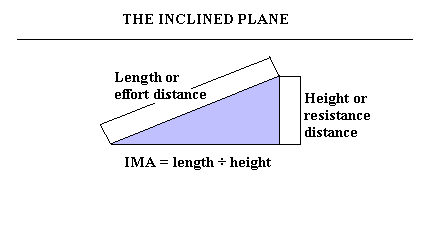
An Inclined plane or a ramp is one of the basic machines. It reduces the force necessary to move a load a certain distanc'e up by providing a path for the load to move at a low angle to the ground. This lessens the needed force but increases the distance involved, so that the amount of work stays the same. Examples are ramps, sloping roads, chisels, hatchets, plows, air hammers, carpenter's planes and wedges. The most canonical example of an inclined plane is a sloped surface; for example a roadway to bridge a height difference. The inclined plane is used to reduce the force necessary to overcome the force of gravity when elevating or lowering a heavy object. The ramp makes it easier to move a physical body vertically by extending the distance traveled horizontally (run) to achieve the desired elevation change (rise). In civil engineering the slope or ratio of rise/run is often referred to as a grade or gradient. Others may also call it tilt. Ramps are used as an alternative for a stairway for wheelchairs, buggies and shopping carts. Ramps may zigzag. There are also moving ramps. By changing the angle of the ramp one can usefully vary the force necessary to raise or lower a load. For example: A wagon trail on a steep hill will often traverse back and forth to reduce the gradient experienced by a team pulling a heavily loaded wagon. This same techique is used today in modern freeways which travel through steep mountain passes. Some steep passes have separate truck routes that reduce the grade by winding along a separate path to rejoin the main route after a particularly steep section is past while smaller automobiles take the straighter steeper route with a resulting savings in time. It is important in the history of science, engineering and technology for a variety of reasons: The ramp or inclined plane was useful in building early stone edifices, in roads and aqueducts, and military assault of fortified positions. Experiments with inclined planes helped early physicists such as Galileo Galilei quantify the behavior of nature with respect to gravity, mass, acceleration, etc. Detailed understanding of inclined planes and their use helped lead to the understanding of how vector quantities such as forces can be usefully decomposed and manipulated mathematically. This concept of superposition and decomposition is critical in many modern fields of science, engineering, and technology. Other simple machines based on the inclined plane include the blade, in which two inclined planes placed back to back allow the two parts of the cut object to move apart using less force than would be needed to pull them apart in opposite directions. MECHANICAL ADVANTAGE OF THE INCLINED PLANE
If an object is put on an inclined plane it will move if the force of friction is smaller than the combined force of gravity and normal force. If the angle of the inclined plane is 90 degrees (rectangle) the object will free fall. The term inclined plane is also used for a funicular. |