What is the structure of the atom? -- Historical Structures of the Atom--
The word atom is derived from the Greek word atom which means indivisible. The Greeks concluded that matter could be broken down into particles to small to be seen. These particles were called atoms
Matter has mass and takes up space. Atoms are basic building blocks of matter, and cannot be chemically subdivided by ordinary means.
Atoms are composed of three type of particles: protons, neutrons, and electron. Protons and neutrons are responsible for most of the atomic mass, e.g in a 150lb. person 149 lbs, 15 oz are protons and neutrons while only 1 oz. is electrons. The mass of an electron is very small (9.108 X 10⁻²⁸ grams).
Both the protons and neutrons reside in the nucleus. Protons have a postive (+) charge, neutrons have no charge --they are neutral. Electrons reside in orbitals around the nucleus. They have a negative charge (-).
It is the number of protons that determines the atomic number, e.g., H = 1. The number of protons in an element is constant (e.g., H=1, Ur=92) but neutron number may vary, so mass number (protons + neutrons) may vary.
The same element may contain varying numbers of neutrons; these forms of an element are called isotopes. The chemical properties of isotopes are the same, although the physical properties of some isotopes may be different. Some isotopes are radioactive-meaning they "radiate" energy as they decay to a more stable form, perhaps another element half-life: time required for half of the atoms of an element to decay into stable form. Another example is oxygen, with atomic number of 8 can have 8, 9, or 10 neutrons.
Historical Models of the atom
JOHN DALTON --
John Dalton in 1803, proposed a modern theory of the atom based on the following assumptions: matter is made up of atoms that are indivisible and indestructible; all atoms of an element are identical; atoms of different elements have different weights and different chemical properties; atoms of different elements combine in simple whole numbers to form compounds; and, atoms cannot be created or destroyed.
BOHR MODEL
Bohr model shows electrons circling the nucleus at different levels or orbitals much like planets circle the sun. Electrons move from one energy state to another but can only exist aft defineite energy levels. The energy absorbed or released when electrons change states is in the form of electromagnetic radiation.
THE WAVE MODEL AND QUANTUM THEORY
The Bohr model was only able to explain the very simplest atoms, like hydrogen. Today's modern day theory is based on mathematics and the properties of waves. The wave model forms the basis for the Quantum Theory. This theory gives the probability of locating electrons in a particular location, unlike assuming electrons orbit the nucleus as in the Bohr model.
All atoms would like to attain electron configurations like noble gases. That is, have completed outer shells. Atoms can form stable electron configurations like noble gases
by:
- losing electrons
- sharing electrons
- gaining electrons.
For a stable configuration each atom must fill its outer energy level. In the case of noble gases that means eight electrons in the last shell (with the exception of He which has two electrons).
Atoms that have 1, 2 or 3 electrons in their outer levels will tend to lose them in interactions with atoms that have 5, 6 or 7 electrons in their outer levels. Atoms that have 5, 6 or 7 electrons in their outer levels will tend to gain electrons from atoms with 1, 2 or 3 electrons in their outer levels. Atoms that have 4 electrons in the outer most energy level will tend neither to totally lose nor totally gain electrons during interactions.
The Periodic Table of Elements will show you the electron configuration for any element you click on.
Making a model of an atom for your school
Do you need to make a model or a drawing of an atom for science class? Jefferson Labs has an excellent page that takes you through this project.
Visualizing Atomic Orbitals
See Atomic Orbitals for 3D Jmol images of Atomic Orbitals.
The atomic orbitals of the hydrogen atom can be visualized as a cloud around the nucleus. The orbital represents a probability of finding the electron at a particular location. Darker regions signify a greater probability. Shown below are the 1s (lowest orbital and the 2s orbital.
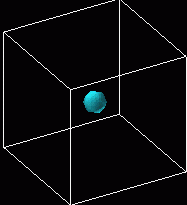 1s
1s
Atomic orbitals do not always have the shape of a sphere. Higher orbitals have very unusual shapes.
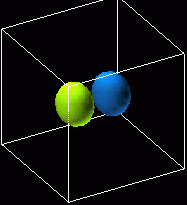 2px
2px
These orbitals were prepared by Dr. Yue-Ling Wong from the University of Florida for more images
How do atoms arrange themselves in molecules?
|
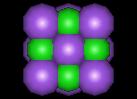
Sodium Chloride (NaCl) is composed of sodium (purple) and chlorine (green atoms). To view the 3-D structure of a salt crystal click here.
|
|
Carbon atoms in graphite- These substance appear as a single giant molecule made up of an almost endless number of covalent bonds. To view the 3-D structure of graphite click here.
|

|
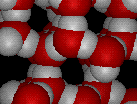
Ice structure showing atoms of oxygen in red and hydrogen atoms in white. To view the 3-D structure of ice click here.
|
 |
Metallic solids are repeating units made up of metal atoms. |
Electricity, Magnetism and Electromagnetism
- Electricity and Magnetism Home
- Electric Charge
- Coulombs Law and Inverse Square Law
- Static Electricity
- The Flow of Electricity
- Electric Current
- Electric Circuits
- Electric Power
- The Nature of Magnets
- Earth as a Magnet
- Magnetism in Action
- Magnetism from Electricity
- Electricity from Magnetism
- How do Transformers Work?
- Ohms Law Lab
- Magnetic Forces Lab
- Why Metals Conduct Electricity
- How does a Battery Work
- How does an Electric Motor Work
Science of Fluids
- Science of Fluids
- What are Fluids?
- What is Pressure?
- What is Hydrostatic Pressure?
- Surface Tension and Capillary Action
- Pascals Principle
- Archimedes Principle
- What is Viscosity?
- Bernouili's Principle