-- BLACK HOLES, WORMHOLES AND WHITE HOLES
What is a Black Hole?
According to the general theory of relativity, a black hole is a region of space from which nothing, including light, can escape. It is the result of the denting of spacetime caused by a very compact mass. Around a black hole there is an undetectable surface which marks the point of no return, called an event horizon. It is called "black" because it absorbs all the light that hits it, reflecting nothing, just like a perfect black body in thermodynamics. Under the theory of quantum mechanics black holes possess a temperature and emit Hawking radiation through slow dissipation by anti-protons.
Despite its undetectable interior, a black hole can be observed through its interaction with matter. A black hole can be inferred by tracking the movement of a group of stars that orbit a region in space. Alternatively, when gas falls into a stellar black hole from a companion star or nebula, the gas spirals inward, heating to very high temperatures and emitting large amounts of radiation that can be detected from earthbound and Earth-orbiting telescopes.
Astronomers have identified numerous stellar black hole candidates, and have also found evidence of supermassive black holes at the center of every galaxy. After observing the motion of nearby stars for 16 years, in 2008 astronomers found compelling evidence that a supermassive black hole of more than 4 million solar masses is located near the Sagittarius A* region in the center of the Milky Way galaxy.
How are Black Holes Formed?
Most black holes are made when a giant star, called a supergiant, at least twenty times bigger than our own Sun dies, and leaves behind a mass that is at least one solar mass. Stars die when they run out of hydrogen or other nuclear fuel to burn and start to collapse.
A supergiant star's death is called a supernova. Stars are usually in equilibrium, which means they are making enough energy to push their mass outward against the force of gravity. When the star runs out of fuel to make energy, gravity takes over. Gravity pulls the center of the star inward very quickly (so quickly that it would have to be repeated several thousand times before it took up a single second), and it collapses into a little ball. The collapse is so fast and violent that it makes a shock wave, and that causes the rest of the star to explode outward. As the gravity pushes the star inward, the pressure in the center of star reaches to such an extreme level that it enables heavier molecules like iron and carbon to interact to release nuclear energy. The release of the energy from the star during a very short period of time (about one hour) is with such a high rate that it outshines an entire galaxy.
The ball in the center is so dense (a lot of mass in a small space, or volume), that if you could somehow scoop only one teaspoon of material and bring it to Earth, it would sink to the core of the planet. If the original star was large enough the densely packed ball is called a singularity, the core of a black hole, but if it was not it would become either a neutron star or a dwarf star. Even without a supernova, a black hole will form any time there is a lot of matter in a small space, without enough energy to act against gravity and stop it from collapsing. If supernovas are so bright, why do we not see them often? Actually, there are usually hundreds of years between naked-eye super nova sightings. It is because the period of being a super nova in a star life cycle is only a few hours out of the billions of years in a star's life span. The probability (chance) of looking at a star in sky and that being in super nova state is equal to the ratio of an hour over several billion years.
It is worth mentioning that all of the heavier materials like carbon, oxygen, all the metals, etc, that make the life on the earth possible and are ingredients of all living creatures, can only form in the extreme pressure at the center of a super nova. So we are all a remnant ash from one exploding star several billion years ago.
Black holes have also been found in the middle of every major galaxy in the universe. These are called supermassive black holes, and are the biggest black holes of all. They formed when the Universe was very young, and also helped to form all the galaxies.
Some black holes are also responsible for making things called quasars. A quasar occurs when a black hole consumes all the gas surrounding it. As the gas gets close to the black hole itself, it heats up from a process called friction, and glows so brightly that this light can be seen on the other side of the Universe. It is often brighter than the whole galaxy the quasar is in. When astronomers first found quasars, they thought they had found objects close to us. After using a measuring technique called red shift, they discovered these quasars were actually very far away in the universe.
What is a Wormhole?
In physics, a wormhole is a hypothetical topological feature of spacetime that would be, fundamentally, a "shortcut" through spacetime. A wormhole is, in theory, much like a tunnel with two ends each in separate points in spacetime. In 1935, Albert Einstein and Nathan Rosen in 1935 first dreamed up the idea of a wormhole. They realized that general relativity allows the existence of “bridges,” originally called Einstein-Rosen bridges but now known as wormholes. These space-time tubes act as shortcuts connecting distant regions of space-time.
See image below that shows how a wormhole connects black holes with white holes.
There is no observational evidence for wormholes, but on a theoretical level there are valid solutions to the equations of the theory of general relativity which contain wormholes. But, assuming that general relativity is correct, there may be wormholes.
What are White Holes?
A white hole, in general relativity, is a hypothetical region of spacetime which cannot be entered from the outside, but from which matter and light may escape. In this sense it is the reverse of a black hole, which can be entered from the outside, but from which nothing, including light, may escape. (However, it is theoretically possible for a traveler to enter a rotating black hole, avoid the singularity, and travel into a rotating white hole which allows the traveler to escape into another universe.[1]) White holes appear in the theory of eternal black holes. In addition to a black hole region in the future, such a solution of the Einstein equations has a white hole region in its past.[2] However, this region does not exist for black holes that have formed through gravitational collapse, nor are there any known physical processes through which a white hole could be formed.
Like black holes, white holes have properties like mass, charge, and angular momentum. They attract matter like any other mass, but objects falling towards a white hole would never actually reach the white hole's event horizon (though in the case of the maximally extended Schwarzschild solution, discussed below, the white hole event horizon in the past becomes a black hole event horizon in the future, so any object falling towards it will eventually reach the black hole horizon).
There are theories suggesting that white holes create new universes from matter originating in another universe's black hole.
| ..."According to a mind-bending new theory, a black hole is actually a tunnel between universes—a type of wormhole. The matter the black hole attracts doesn't collapse into a single point, as has been predicted, but rather gushes out a "white hole" at the other end of the black one, the theory goes. ..[Reference] |
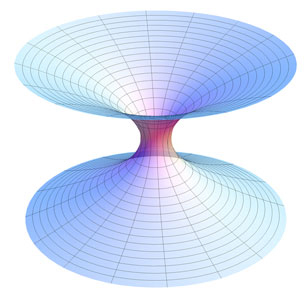 |
HOW ARE BLACK HOLES AND WHITE HOLES CONNECTED VIA A WORMHOLE Einstein-Rosen bridges like the one visualized above have never been observed in nature, but they provide theoretical physicists and cosmologists with solutions in general relativity by combining models of black holes and white holes Source and Credit: Our universe at home within a larger universe? |
|
Photo
by AllenMcC (Creative Commons Attribution Sharealike 3.0) |
TEST YOUR KNOWLEDGE OF THE MATERIAL
Solar System
- Table of Contents
- Introduction
- About the Solar System
- The Sun
- Mercury
- Venus
- Earth
- Moon
- Mars
- Asteroid belt
- Jupiter
- Saturn
- Uranus
- Neptune
- Pluto
- Comets
- Kuiper Belt
- Oort Cloud
- How the Solar System was born
- What will happen to the Solar System in the future
- Solar System/Space exploration
- Glossary
Beyond The Solar System
Earth Systems
- Layers of the Earth -- What are the different types of Seismic Waves
- What causes precipitation? What causes it to rain or snow? What causes dew on the ground?
- What is the Coriolis Effect?
- About gravity, mass, and weight
- What are seismic waves? What are the different types of seismic waves?
- What is Humidity? How is Humidity Measured?
- What causes precipitation --( rain or snow)?
HTML5 Simulations
Scientific Notation and Units and Measurement
All text is available under the terms of the GNU Free Documentation License (see Copyrights for details). Disclaimers. Wikipedia is powered by MediaWiki, an open source wiki engine.