
EXERCISE COULD SLOW AGING -- MOLECULAR LEVEL DATA NOW IN
A study, involving more than 2,400 British twins, found for the first time that exercise appears to slow the shortening of telomeres.
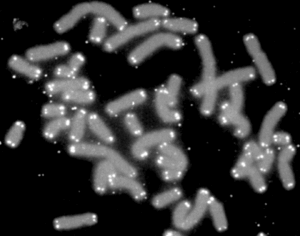
Telomeres cap the ends of chromosomes, the structures that carry genes. Every time a cell divides, the telomeres get shorter. When the telomeres get too short, the cell can no longer divide and die.
Abstract: The Association Between Physical Activity in Leisure Time and Leukocyte Telomere Length
Lynn F. Cherkas, PhD; Janice L. Hunkin, BSc; Bernet S. Kato, PhD; J. Brent Richards, MD; Jeffrey P. Gardner, PhD; Gabriela L. Surdulescu, MSc; Masayuki Kimura, MD, PhD; Xiaobin Lu, MD; Tim D. Spector, MD, FRCP; Abraham Aviv, MD
Arch Intern Med. 2008;168(2):154-158.
The Study
A group of 2,401 white twins was studied by Tim D. Spector, a professor of genetic epidemiology at King's College London, and colleagues and was published in the Archives of Internal Medicine. The team administered questionnaires related to physical activity level, smoking habits, and social and economic factors. The participants also provided a blood sample, and DNA was extracted from the white blood cells (leukocytes.) The leukocyte DNA samples were analyzed for the length of their telomeres at each end of the chromosomes. Spector and his colleagues analyzed the telomeres from white blood cells collected from participants examining whether there was a relationship between the subjects' telomere length and how much exercise they got in their spare time over a 10-year period.
Results
"Results Leukocyte telomere length was positively associated with increasing physical activity level in leisure time (P < .001); this association remained significant after adjustment for age, sex, body mass index, smoking, socioeconomic status, and physical activity at work. The LTLs of the most active subjects were 200 nucleotides longer than those of the least active subjects (7.1 and 6.9 kilobases, respectively; P = .006). This finding was confirmed in a small group of twin pairs discordant for physical activity level (on average, the LTL of more active twins was 88 nucleotides longer than that of less active twins; P = .03). " Source
People who did a moderate amount of exercise -- about 100 minutes a week of activity such as tennis, swimming or running -- had telomeres that on average looked like those of someone about five or six years younger than those who did the least -- about 16 minutes a week. Those who did the most -- doing about three hours a week of moderate to vigorous activity-- had telomeres that appeared to be about nine years younger than those who did the least. As the amount of exercise increased, the telomere length increased.
Conclusions
The researchers conclude that a sedentary lifestyle (in addition to smoking, high body mass index, and low socioeconomic status) has an effect on telomere length and may accelerate the aging process. This can provides a powerful message that could be used by clinicians to promote the potentially antiaging effect of regular exercise.
About Telomeres During cell division, the enzymes that duplicate the chromosome and its DNA can't continue their duplication all the way to the end of the chromosome. If cells divided without telomeres, they would lose the end of their chromosomes, and the necessary information it contains. (In 1972, James Watson named this phenomenon the "end replication problem.") The telomere is a disposable buffer, which is consumed during cell division and is replenished by an enzyme. This mechanism usually limits cells to a fixed number of divisions, and animal studies suggest that this is responsible for aging on the cellular level and affects lifespan. Telomeres protect a cell's chromosomes from fusing with each other or rearranging. These chromosome abnormalities can lead to cancer, so cells are normally destroyed when telomeres are consumed. Most cancer is the result of cells bypassing this destruction. Biologists speculate that this mechanism is a tradeoff between aging and cancer. Source: Wikipedia |
TELOMERES ARE SHOWN AS THE WHITE CAPS AT THE END OF CHROMOSOMES IN THE ABOVE IMAGE. |
Edinformatics News Feeds
- Science (General)
- Science Specific
- Health and Medicine
- Cancer EurekAlert
- Infectious and Emerging Diseases
- Environmental and Atmospheric Sciences
- Mathematics News
- Food and Nutrition
- Chemistry and Physics News
- Nanotechnology News
- NASA Universe
- Space and Planetary News
- Science Education
- Business and Stocks
- Global News
- Culinary News
- New York Times Book Review
- Education Week News
- Entertainment News
- Sports News
- Science News for Kids